Week 5b: Continuity
- Feb 17, 2020
- 2 min read
Alex Esclamado
This past week I worked to better understand the Brimrose AOD. I connected it to the MDO4104C Mixed Domain Oscilloscope and connected the driver to my laptop. After spending some time debugging connection and permission issues, I was able to utilize the driver via the DS1 software. Per the manual, the AOD has a center frequency of 140 MHz with a bandwidth of 80 MHz. Using the software, I set the frequency to 100, 140, and 180, then slowly stepped through from 100 to 180 MHz and observed the waveform on the oscilloscope. Pictures of the error, software, and waveforms (in increasing frequency) can be found below. I am now able to comfortably startup the AOD via my personal computer while the main workstation is in use with software development.
For the oscilloscope, I have discussed with Dr. Asghari the potential workaround that involves opening the scope and he is open to the idea. I have contacted Tektronix and am awaiting their response in regards to the possibility of it working.
This coming week I plan to work with Dr. Asghari to learn how to synchronize the probes with different dispersions via interchanging the fibers after the circulator stage.


Trevor Wong
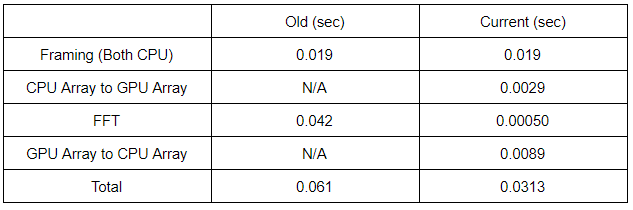
This past week I worked with simple FFT code using CuPy. From my tests in order to see an improvement in speed between NumPy and CuPy, there needs to be over 10 million data points. In addition with more points, the faster CuPy is over NumPy. With that working, I attempted to integrate CuPy into the processing.py code. This is where my current obstacle revealed itself. The interpreter for the system’s code is using the Anaconda distribution of Python, while my tests were on the official Python distribution. The problem here is that CuPy for Anaconda is at version 6.0.0, while the official is 7.2.0. The older version should not be a problem, but the test FFT codes no longer run properly. I received an error stating that CuPy has no FFT method, which should not be the case. Within the documentation of 6.0.0, it clearly shows that this version has various FFT functions. I’ve tried reinstalls, restarts, and updates to no avail. I hypothesize that the package may have been installed incorrectly or a step in missing in the installation process. I will be focusing on getting this working in the coming week.
Comments