Week 6b: Figuring It Out
- Feb 23, 2020
- 2 min read
Alex
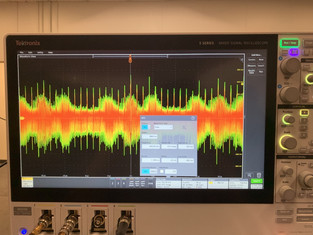
This past week I worked more on the AOD with Dr. Asghari. This time, we employed the MS054 oscilloscope to utilize its fast acquisition mode in order to observe the output of more closely. Next, we turned to using the driver’s scan controls. We found it difficult to discern what the output waveform was demonstrating and were confused as to whether the scan function was working correctly. I later came in and ran multiple tests with the scan controls, changing parameters such as the units from wavelength to frequency, the range and step sizes. Additionally, the MS054’s function generator was applied as a means to modulate the signal. I used different waveform types, primarily sinusoidal, square, and pulses, and changed the frequency, width, and amplitude among other parameters. I was still unable to see an obvious sweeping output via the scope even though I am fairly confident the controller was set correctly. I have contacted Brimrose in order to gain support in what results we should expect when testing this device in addition to steps to verify proper functionality. Hopefully a reply will come soon and I can further work with Dr. Asghari on implementing the device for the system.




Trevor
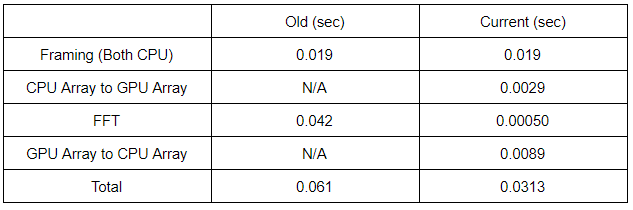
Last week I decided to create a new Python virtual environment for the project using the official distribution of Python rather than the Anaconda variant used prior. This is because Anaconda is missing the newer 7.2.0 version of CuPy, only having the 6.0.0 version, and installing the new version via pip did not prove a viable solution. With this environment I opted to use Python 3.7.6 as it is the newest version in the 3.7 line and because the 3.8 line does not currently support packages like mayavi. I was able to get this environment working with the system code using a previously captured waveform for testing. Currently I am working on converting the CPU handled fft of the the system code to a GPU handled one. It is not as simple as a swap from NumPy to CuPy as from what it seems so far the data going into CuPy's fft function differs from that going into NumPy's fft function. Thus, this week I will be trying to figure out what that difference is and how I can convert our waveform array to be compatible with CuPy's fft.
Comments